Tertarik? Hubungi kami sekarang
Untuk menghubungi kami, silakan isi formulir di sebelah kanan atau email langsung ke alamat di bawah ini
sales@senecaesg.comThe world has been witnessing a paradigm shift in the way business success is defined. No longer is it just about profitability and revenue growth; companies are now also evaluated based on their performance in Environmental, Social, and Governance (ESG) aspects. Investors, consumers, and regulatory agencies are increasingly looking at ESG metrics and Key Performance Indicators (KPIs) to make informed decisions. But what are these metrics and KPIs, and how do they redefine the measurement of business success? This article aims to shed light on the subject.
What Are ESG Metrics and KPIs?
ESG Metrics are quantifiable measures that reflect a company’s performance in the domains of environmental stewardship, social responsibility, and governance integrity. These metrics may range from carbon emissions and water usage to workforce diversity and board structure.
KPIs (Key Performance Indicators) in the ESG context are specific, narrowly-defined metrics that are identified as particularly crucial for assessing performance. For example, a company may designate its “carbon intensity per unit of production” as a KPI in its efforts to combat climate change.
Environmental Metrics
Carbon Footprint
One of the most well-known metrics, the carbon footprint quantifies the total greenhouse gas emissions caused by an entity. It is often broken down further into scopes 1, 2, and 3, which respectively refer to emissions from owned operations, purchased electricity, and supply chain activities.
Waste Management
Companies often report on the amount and types of waste they generate, including hazardous waste, and the percentage that is recycled or reused.
Water Usage
Water metrics might include total water consumption, water recycling rates, and measures to reduce water wastage.
Social Metrics
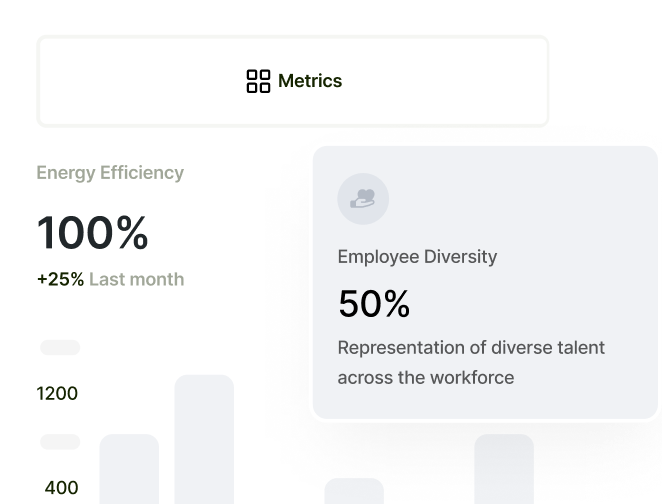
Workforce Diversity
Metrics here can include the gender ratio, ethnicity representation, and inclusion indices within a company.
Employee Satisfaction
Often gauged through surveys, employee satisfaction can be a critical indicator of a company’s social performance.
Community Engagement
Metrics could involve charitable giving, volunteer hours, or community development projects led by the company.
Governance Metrics
Board Composition
This pertains to the diversity and qualifications of the company’s board members, including the ratio of independent directors.
Executive Compensation
Transparency in how executives are rewarded, and whether their compensation is tied to ESG performance can be revealing metrics.
Compliance and Ethics
Metrics might include the number of regulatory fines, instances of corruption, or other legal issues the company has faced.
The Importance of ESG KPIs
Prioritization
The designation of certain metrics as KPIs helps businesses prioritize their efforts. For example, if reducing the gender pay gap is a KPI, it is likely to receive more attention and resources.
Target Setting
KPIs facilitate the setting of specific, measurable targets. If a company sets a KPI for reducing carbon emissions by 20% by 2025, it provides a clear goal to strive for.
Stakeholder Communication
Clear KPIs also make it easier to communicate performance and intentions to stakeholders, be it investors who are looking for ESG-compliant companies to invest in or consumers looking to make ethical choices.
Challenges and Solutions
Data Consistency
The lack of standardization in ESG metrics can make it challenging to compare performances. Utilizing widely-accepted reporting frameworks like the Global Reporting Initiative (GRI) can help improve consistency.
Complexity
The vast array of possible ESG metrics can be overwhelming. Businesses should focus on the metrics most material to their operations and stakeholders.
Conclusion
The significance of ESG metrics and KPIs in today’s business landscape cannot be overstated. These numbers go beyond the traditional financial metrics to offer a more holistic view of a company’s success, one that also considers environmental sustainability, social responsibility, and governance integrity. By focusing on these comprehensive metrics, businesses not only stand to improve their brand image and stakeholder relations but also gain a competitive edge in an increasingly conscious global market.
Pantau kinerja ESG di portofolio, buat kerangka ESG Anda sendiri, dan ambil keputusan bisnis yang lebih baik.
Untuk menghubungi kami, silakan isi formulir di sebelah kanan atau email langsung ke alamat di bawah ini
sales@senecaesg.com7 Straits View, Marina One East Tower, #05-01, Singapura 018936
+(65) 6223 8888
Carrer de la Tapineria, 10
Ciutat Vella, 08002, Barcelona, Spain
+34 612 22 79 06
77 Dunhua South Road, 7F Section 2, Distrik Da'an Taipei City, Taiwan 106414
(+886) 02 2706 2108
Av. Santo Toribio 143,
San Isidro, Lima, Peru, 15073
(+51) 951 722 377