Interested? Contact us now
In order to contact us please fill the form on the right or directly email us at the address below
sales@senecaesg.com“The change wrought by the COVID-19 crisis and its aftermath will teach us about priorities, resilience, and demand in ways that we did not dare test before,” said Michel Couillard, the Counselors of Real Estate (CRE). The CRE, an international advisory firm focusing on the real estate industry, has identified ESG as one of the current and emerging issues that is expected to have the most significant impact on real estate.
According to a report from the CRE, ESG practices are no longer an emerging trend, but a critical component of real estate investment integrated into investment decision-making. COVID-19 has further cemented this paradigm shift as risk management, resiliency, transparency, and social engagement take center stage.
In China, the real estate industry presents an important position in the national economy. It has played a major role in the country’s steady economic growth. However, it has faced prominent challenges regarding sustainability, and ESG overall, especially in regards to environmental sustainability.
Overview of China’s Real Estate Industry from an ESG Perspective
Diversified green financial instruments have been developed to support the real estate industry. At present, green financial instruments in China’s real estate industry are mainly focused on green loans and green bonds. According to a report from PBoC, by the end of 2019, the balance of domestic and foreign currency green loans was RMB10.22 trillion. Funds involved are mainly invested in the field of green transportation, renewable energy and clean energy. For developers, owners and occupiers of prime real estate, sustainability is now intrinsically linked with quality. Environmental credentials have also become a form of quality control, such as Leadership in Energy and Environmental Design (LEED) or some other local certification. Also, more real estate players are signing on to the Global Real Estate Sustainability Benchmark (GRESB). GRESB requires asset managers to report environmental policies and performance, with data then made available for use by investors to support their allocations of capital.
ESG Performance of China’s Listed Real Estate Companies
Recently, China Index Holdings (CIH:US) issued a report on China’s listed real estate companies. As a local data and technology operator focusing on the real estate market, CIH has also created its own ESG rating framework, the China Real Estate Sustainability Benchmark (CRESB). With three main pillars, 10 sub-categories, CIH uses its ESG rating framework to rate the ESG performance of Chinese-listed real estate companies.
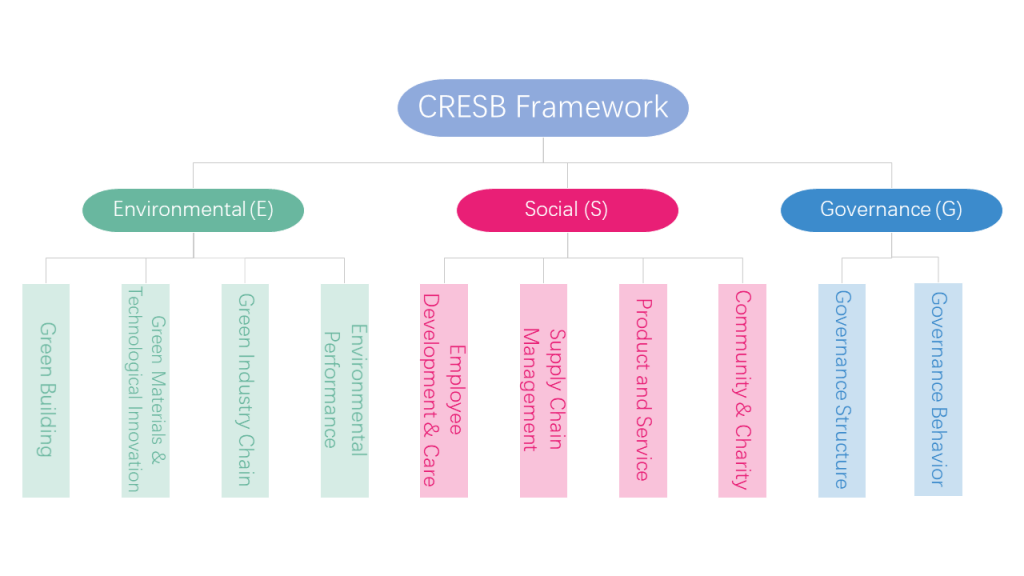
According to CIH, for A-share companies, 53% of them have issued their ESG reports while for H-share companies, the percentage is much higher at 94%. Unfortunately, quantitative information appears insufficient in most real estate companies’ ESG reports. More so, only 31% of them released an independent ESG report. Lastly, only 3.36% of the ESG reports have been assured by an independent third-party auditor.
EY Global Climate Change and Sustainability Service (CCaSS) identifies corporate governance as a major trend that could both pose challenges and opportunities to real estate markets in China. Currently, 60% of Chinese real estate corporations still lack a board of directors participating in ESG affairs, though the participation is increasing year by year, with nearly 18% of ESG committees of real estate companies directed by the board.
Chinese real estate companies have taken positive actions to improve ESG management. For example, most of them have set up sustainable development goals, engaged in new technology research and innovation to improve efficiency, and developed green finance solutions as well as social charities. However, disclosure, transparency and reliability of ESG information in the real estate industry need to be improved, and still has a long way to go.
Reference
https://www.cre.org/the-counselor/summer-2020/2020-2021-top-ten-issues-affecting-real-estate/
https://fdc.fang.com/report/13378.htm
http://www.esgzh.com/ESG/1041.html
https://gresb.com/expect-china-real-estate-industry-2019/
https://www.pwccn.com/en/real-estate/emerging-trends-in-real-estate-asia-pacific-2020.pdf

Scan to follow Seneca ESG on WeChat
Monitor ESG performance in portfolios, create your own ESG frameworks, and make better informed business decisions.

In order to contact us please fill the form on the right or directly email us at the address below
sales@senecaesg.com7 Straits View, Marina One East Tower, #05-01, Singapore 018936
+(65) 6223 8888
Carrer de la Tapineria, 10
Ciutat Vella, 08002, Barcelona, Spain
+34 612 22 79 06
77 Dunhua South Road, 7F Section 2, Da'an District Taipei City, Taiwan 106414
(+886) 02 2706 2108
Av. Santo Toribio 143,
San Isidro, Lima, Peru, 15073
(+51) 951 722 377